Only 79,00€ away from free shipping
No products in the cart.
3,50 €
Only 1 left in stock (can be backordered)
Order within 13 h 54 min and we ship today
Arrives approx. Thu 19.11. – Mon 23.11. · to a pickup point or your home
Free collection in store, usually the same day
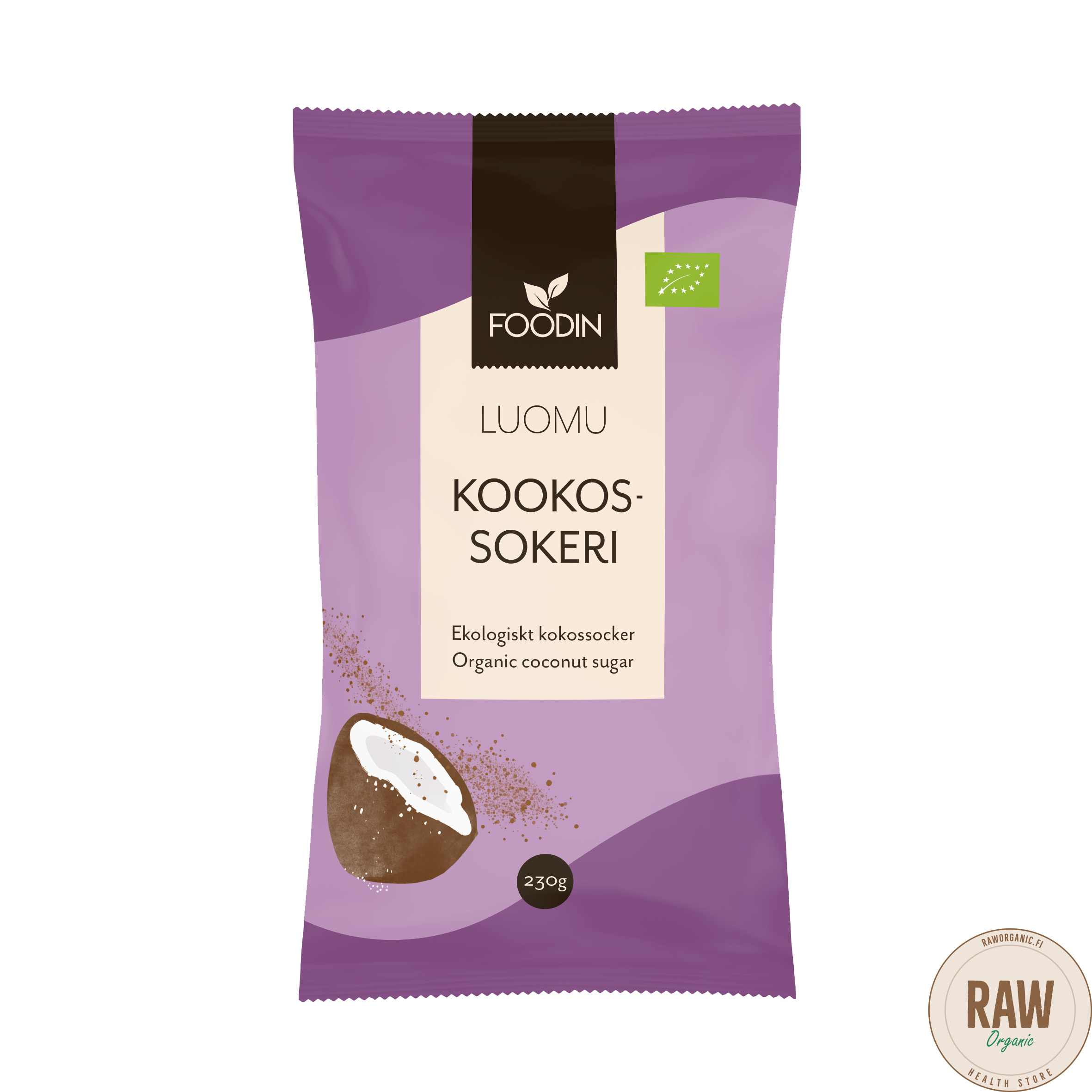
Foodin’s coconut sugar is a natural sweetener that has been dubbed the world’s most ecological sweetener. Our coconut sugar is made 100% by hand from the nectar of coconut palm blossoms, ethically and in accordance with sustainable development.
Coconut sugar can be produced from several different varieties of coconut palm, of which there are more than 1,600. Unfortunately, in the case of many palms, rainforests have to be cleared in order to exploit them. Foodin’s coconut sugar is made exclusively from ethically harvested coconut palms (Cocos nucifera).
Coconut sugar is produced by hand, boiling down the coconut nectar in a particularly gentle manner. Due to the production method, the coconut sugar is not as caramelised as it might normally be. For the same reason, the sugar’s shade is also lighter than usual.
Due to its flavour, nutrient density and ecological nature, coconut sugar is undoubtedly one of the best crystalline sweeteners available to us. It contains an abundance of minerals and other nutrients that are completely removed from bleached sugar.
The taste of coconut sugar is very close to that of muscovado sugar, but its caramel-like nuance makes it especially loveable and a favourite among many top chefs for sweetening.
Use coconut sugar just like regular sugar in:
Tip: Combine coconut sugar and stevia in baking, smoothies or, for example, in the preparation of raw chocolate.
Compared to other sugars, coconut sugar has a very low glycemic index (GI 35), which is why it does not raise blood sugar radically. This makes the sugar a good option for diabetics, for instance*.
*Source: Food and Nutrition Research Institute & Department of Science Technology of the Philippines. The Philippine Food and Nutrition Research Institute, COMPARISON OF THE ELEMENTAL CONTENT OF 3 SOURCES OF EDIBLE SUGAR – Analyzed by PCA-TAL, Sept. 11, 2000. (MI Secretaria et al, 2003) in parts per million (ppm or mg/li), USD
Foodin’s coconut sugar is a natural sweetener that has been titled the world’s most ecological sweetener. Our coconut sugar is made 100% by hand from nectar obtained from the flowers of the coconut palm, ethically and in accordance with sustainable development.
Coconut sugar can be produced from many different coconut palm varieties, of which there are over 1600 different types. Unfortunately, in the case of many palms, rainforests have to be cut down in order to utilize them. Foodin’s coconut sugar is made only from ethically harvested coconut palms (Cocos nucifera).
Coconut sugar is produced by hand by boiling coconut nectar down particularly gently. Due to this method of production, the coconut sugar is not as caramelized as it normally might be. For the same reason, the shade of the sugar is also lighter than usual.
Because of its flavor, nutrient density and ecological nature, coconut sugar is definitely one of the best crystalline sweeteners available to us. It contains plenty of minerals and other nutrients that have been completely removed from bleached sugar.
The taste of coconut sugar is very close to muscovado sugar, but the caramel-like nuance makes it particularly lovable and a favorite for sweetening among many top chefs as well.
Use coconut sugar like regular sugar in desserts, baking, hot drinks, cold mocktails, and on top of porridge, yogurt and pancakes. Tip: Combine coconut sugar and stevia in baking, smoothie drinks or, for example, in the preparation of raw chocolate.
Compared to other sugars, coconut sugar has a very low glycemic index (GI 35), which is why it does not raise blood sugar radically. This makes the sugar a good option for diabetics*, for example.
*Source: Food and Nutrition Research Institute & Department of Science Technology of the Philippines. The Philippine Food and Nutrition Research Institute, COMPARISON OF THE ELEMENTAL CONTENT OF 3 SOURCES OF EDIBLE SUGAR – Analyzed by PCA-TAL, Sept. 11, 2000. (MI Secretaria et al, 2003) in parts per million (ppm or mg/li), USD
Contains no additives or preservatives.
Packed in a factory that handles nuts (cashew, brazil, pecan, macadamia, hazelnut and walnut), almonds, sesame seeds, milk protein and gluten-free oats.
Energy: 1255 kJ / 300 kcal
Fat: 0 g
-of which saturates: 0g
Carbohydrates: 91.9 g
– of which sugars: 86.6 g
Protein: 1.2 g
Salt: 0.5 g
Coconut blossom sugar
Product information is based on details provided by the manufacturer, and the manufacturer may change the composition. Always check the ingredients, nutritional information and directions on the package before use.
| Unit | kpl |
|---|---|
| Best before date and batch number | Marked on the package |



Reviews
There are no reviews yet